
You found a chandelier you love. It looks perfect in the photos.
But then the pendant light arrives, you hang it up, and… something’s off.
It’s too small for your dining table. Or it hangs so low your tallest friend almost hits his head. Or it looks lost in your two-story entryway.
The problem isn’t the light. It’s the size.
In this post, we’ll show you the exact formulas and measurements to size a chandelier, pendant, or island light for any room — no guesswork required.
The #1 Mistake Buyers Make
Buying a chandelier based on how it looks in a photo, without measuring first.
A light that looks “medium-sized” on a website might be 18 inches wide. A light that looks “huge” might be 32 inches wide. Without a reference point, your eyes will deceive you.
Here’s a simple trick:
Before you buy, cut a piece of cardboard or paper to the diameter of the chandelier you’re considering. Tape it to the ceiling or hold it over your table. Stand back and look.
This 5-minute test will save you from returns, restocking fees, and regret.
The Golden Rule for Chandelier Diameter
This is the formula most lighting designers use:
Room length (ft) + Room width (ft) = Chandelier diameter (inches)
Example:
Your dining room is 16 ft x 8 ft.
16 + 8 = 24
Your chandelier should be around 24 inches in diameter.
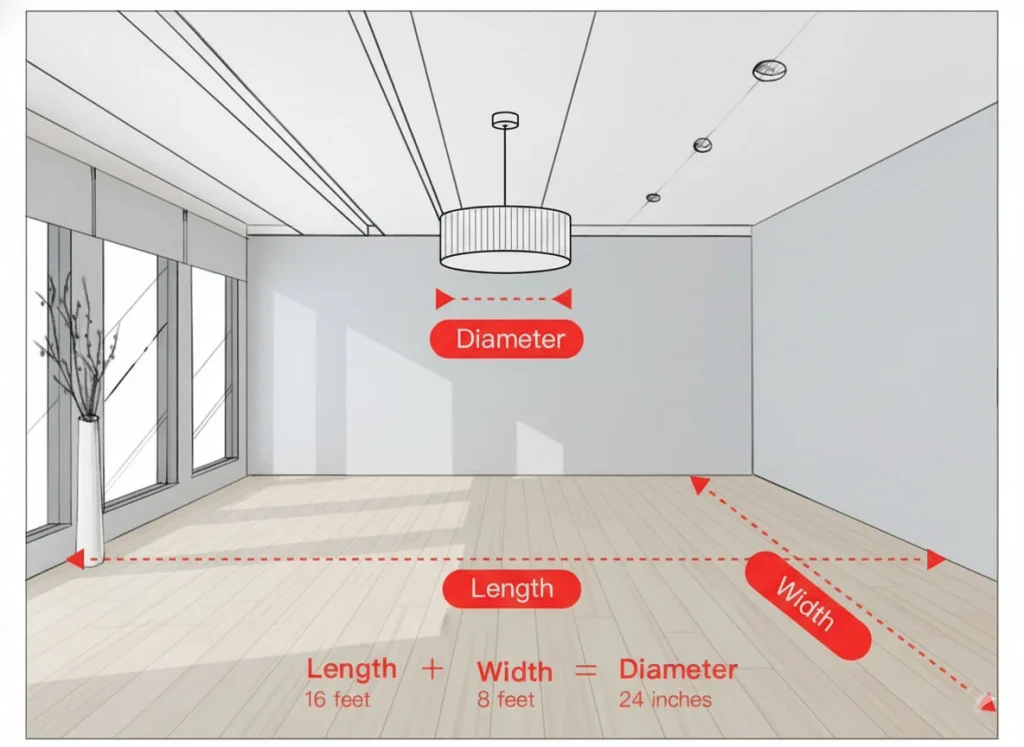
This works best for dining rooms, living rooms, and entryways where the chandelier is the main light source.
Important: This formula gives you a starting point. If your chandelier is airy and open — like a metal cage or thin arms — you can go 2–4 inches larger. If it’s heavy and solid — like a drum shade or dense crystal — stay close to the formula or go slightly smaller.
Sizing for a Dining Table
If your chandelier hangs directly over a dining table, use the table as your reference instead:
Chandelier diameter = 1/2 to 2/3 the width of the table
Examples:
| Table Width | Recommended Chandelier Diameter |
|---|---|
| 36 in | 18–24 in |
| 40 in | 20–27 in |
| 48 in | 24–32 in |
| 54 in | 27–36 in |
For round tables: Use the same rule. A 48-inch round table calls for a chandelier around 24–32 inches in diameter.
For long rectangular tables: Don’t use a round chandelier. Use a linear island light or a rectangular chandelier. Aim for a fixture that’s about 1/2 to 2/3 the length of the table.
How High to Hang It
Getting the height wrong is the fastest way to make a beautiful light look bad.
Here are the standard hanging heights for the most common scenarios:
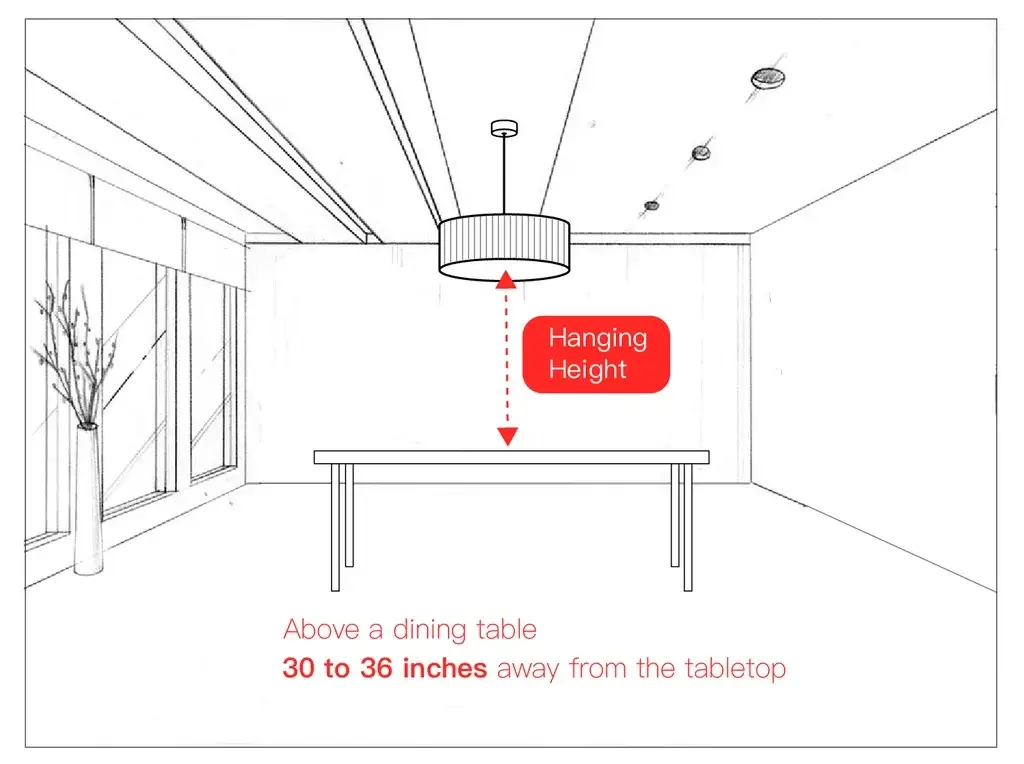
Over a Dining Table or Kitchen Island
- Bottom of the light should be 30–36 inches above the tabletop.
- This works for standard 8-foot ceilings.
- If you have tall family members or a low-hanging fixture style, stick closer to 36 inches.
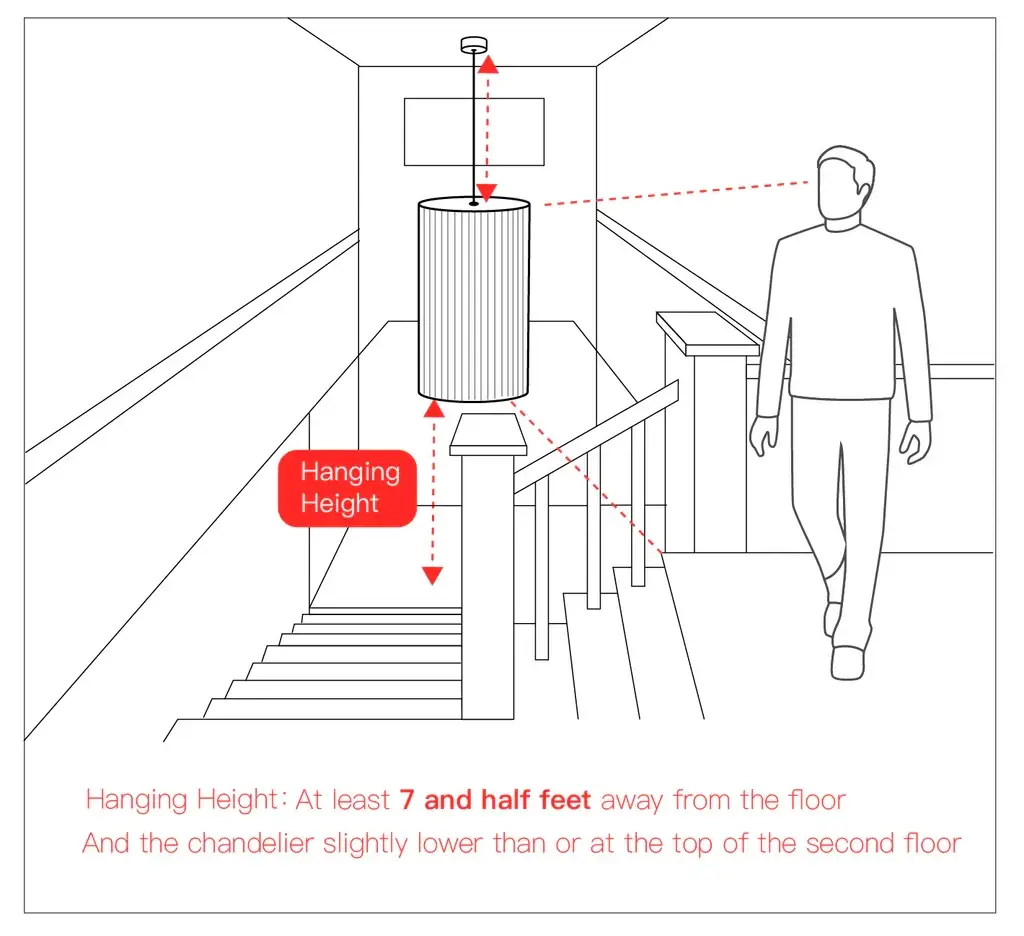
In an Entryway or Hallway
- Bottom of the light should be at least 7 feet from the floor.
- If your ceiling is 8 feet, you only have about 12 inches of hanging space — so a chandelier may not work at all. Consider a semi-flush mount instead.
Quick Recap
- Chandelier diameter = room length + room width (in feet) = inches
- Over a dining table = 1/2 to 2/3 the table width
- Kitchen island pendants = 8–12 inches each, one per 24 inches of island
- Height over table or island = 30–36 inches from the surface
- Entryway clearance = at least 7 feet from the floor
- Always test with cardboard before buying
What’s Next?
Now you know which type of light you need — and what size to buy.
But there’s one more thing most people get wrong: Brightness.
How many lumens do you actually need for a dining room? What’s the best color temperature for a kitchen island? And should you get dimmable lights?
We’ll cover all of that in the next post.