
In the previous articles, we covered how to distinguish different types of pendant lights and how to choose the right height and number of pendant lights based on room dimensions. Next, we will discuss another parameter that cannot be ignored when choosing a pendant light—the target brightness of the room.
What Is Target Brightness ?
Target brightness, simply put, is the brightness you want the room to achieve. It is not a parameter of the fixture itself, but a target value set first during lighting design. Different room types require different target illuminance levels. Generally, the target illuminance for various room types is as follows (unit: lux, lx):
| Space | Target Illuminance |
|---|---|
| Hallways, storage rooms | 50–100 lx |
| Bedroom, general activities | 50–150 lx |
| Living room, general activities | 100–200 lx |
| Dining table surface | 150–300 lx |
| Kitchen countertop | 300–500 lx |
| Study/reading | 300–500 lx |
| Detailed work | 500–1000 lx |
What Determines Target Brightness ?
Target illuminance mainly depends on the total lumens of the light fixtures and the area of the room.
The usual formula is:
Target illuminance (lux) = Total lumens × 10.7639 / Room area (sq ft)
Note: When the room has a dark décor style, or the user is an elderly person, increase the room’s target brightness by about 1.5 times. Dark walls usually absorb more luminous flux, and elderly people need more brightness than younger people.
In addition to target brightness, there are other parameters to pay attention to when buying pendant lights.
Color Temperature
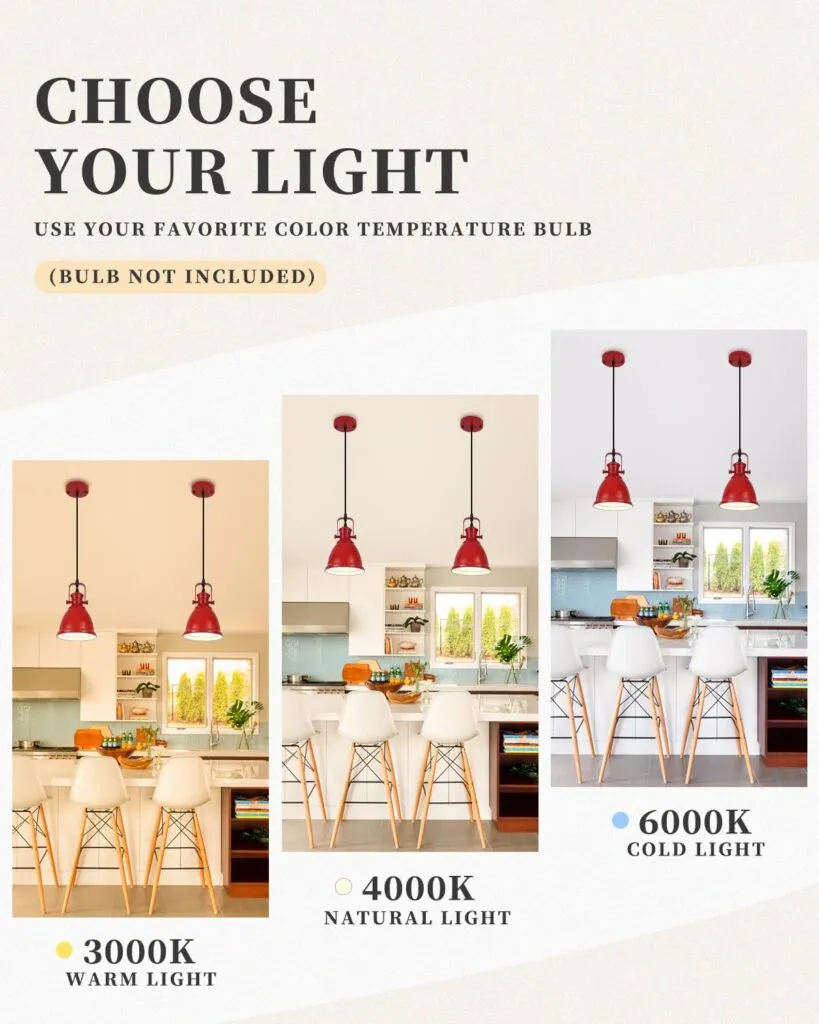
Color temperature determines the color of the light emitted by the pendant light. The color temperature of ordinary pendant lights is generally in the range of 3000–6000K. The closer to 3000K, the warmer and more yellow the light; the closer to 6000K, the cooler and whiter the light.
Color Rendering Index Ra/CRI
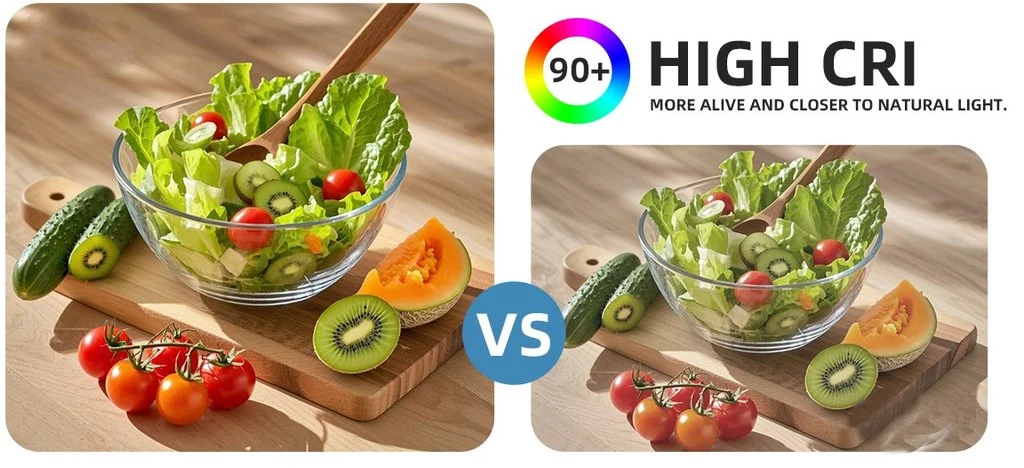
The color rendering index Ra, commonly called CRI, indicates how accurately objects’ colors are reproduced when illuminated. The higher the CRI, the more true-to-life the colors. CRI is not related to color temperature. Ra is usually required to be greater than 90.
Power
The power of a pendant light mainly affects its electricity consumption. Power does not equal brightness, but it affects luminous flux.
Common light source efficacy reference:
| Light Source Type | Luminous Efficacy |
|---|---|
| Incandescent | 10–15 lm/W |
| Halogen | 15–25 lm/W |
| Fluorescent/CFL | 50–70 lm/W |
| Standard LED | 80–120 lm/W |
| Premium LED | 120–160 lm/W |
| High-CRI LED | 80–120 lm/W, usually slightly lower |
If the pendant light has a shade, crystal, or glass obstruction, the light output efficiency will decrease:
| Obstruction | Light Output Efficiency |
|---|---|
| Open downward, unobstructed | 80%–90% |
| Translucent shade | 60%–80% |
| Enclosed shade, crystal chandelier | 40%–60% |
How to Calculate Pendant Light Power?
First calculate how many lumens the room needs, then divide by luminous efficacy and fixture efficiency.
Example:
A living room needs 5,200 lm. Using LEDs with a luminous efficacy of 100 lm/W and a fixture efficiency of 0.8:
Total power = 5,200 / 100 / 0.8 = 65W
So this living room needs about 65W of total LED power.
What’s Next?
Now you know what parameters and styles to choose for your home’s pendant light.
Next, we will discuss how to choose the material and surface finish of pendant lights.
Brass, matte black, or glass—which material is suitable for your home?
We will cover all of this in the next article.